
AI and the Earth: Climate Threat or Sustainability Superpower?

How Artificial Intelligence Is Reshaping the Future of the Planet
Artificial Intelligence is no longer a futuristic concept sitting inside research labs — it is now embedded in almost every part of modern life. From personalized mobile experiences and fraud detection to predictive business analytics, automated customer service, and intelligent marketing, AI has become the silent engine behind today’s digital economy.

But as businesses race to adopt smarter systems, a more uncomfortable question is beginning to surface:
Is AI helping humanity move toward a greener future, or is it quietly becoming a new environmental burden?
At Webdzo Technologies, we believe this is one of the most important technology conversations of 2026.
Because while AI is revolutionizing industries, it is also consuming unprecedented amounts of energy, water, hardware, and infrastructure. The global expansion of AI-driven data centers is now creating a visible carbon footprint, forcing companies worldwide to rethink what “smart technology” truly means. Recent industry estimates show that data-center electricity usage is rising sharply year after year, and environmental analysts warn that unchecked AI growth could become one of the decade’s fastest-growing digital sustainability challenges.
The Hidden Environmental Cost Behind AI Growth
Most people experience AI as something intangible — a chatbot response, an automated recommendation, a content suggestion, or a predictive report. What they do not see is the massive physical ecosystem operating behind every AI interaction.

Every intelligent query travels through high-performance servers running continuously inside giant data centers. These facilities require:
- enormous electricity to power AI processors,
- constant cooling systems to prevent overheating,
- huge quantities of water,
- and regular hardware replacement due to short AI server life cycles.
Today, a single AI-focused data center can consume energy at the scale of a small city and millions of gallons of cooling water in a day. As AI adoption accelerates, thousands of such facilities are being planned globally to support machine learning, generative AI, autonomous systems, and real-time enterprise automation.
This means AI is no longer just a software story.
It is now an infrastructure story.
And infrastructure always leaves an environmental footprint.
Carbon Emissions: The Silent Side Effect of Intelligence
Training large AI models is only one part of the equation.
The real long-term impact comes from continuous deployment — millions of users asking questions, generating content, analyzing files, automating workflows, and using AI-powered apps every second. Each interaction triggers cloud computation, and when this demand scales globally, the energy draw becomes enormous.
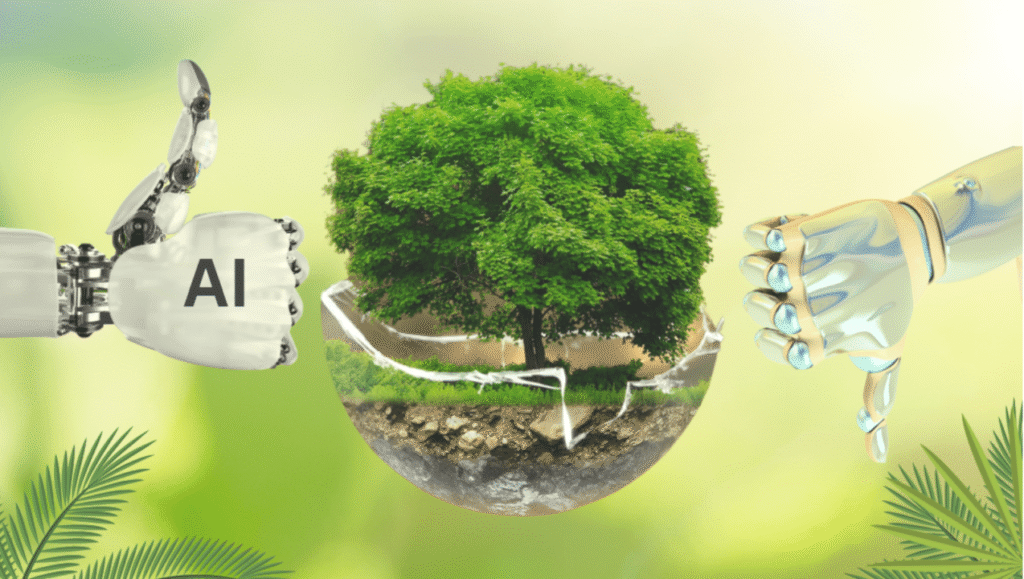
Environmental researchers now estimate that if AI infrastructure expands without aggressive renewable adoption, annual emissions from AI-supporting systems could rise dramatically before the end of this decade. Some recent projections even suggest AI facilities may become one of the fastest-rising contributors to industrial electricity-based emissions if sustainability policies fail to keep pace.
So yes, AI has a real climate cost.
But that is only half the story.
Why AI Could Also Become Climate’s Greatest Ally
The same technology consuming resources also has the power to optimize how the world uses resources.
This is where the narrative shifts.
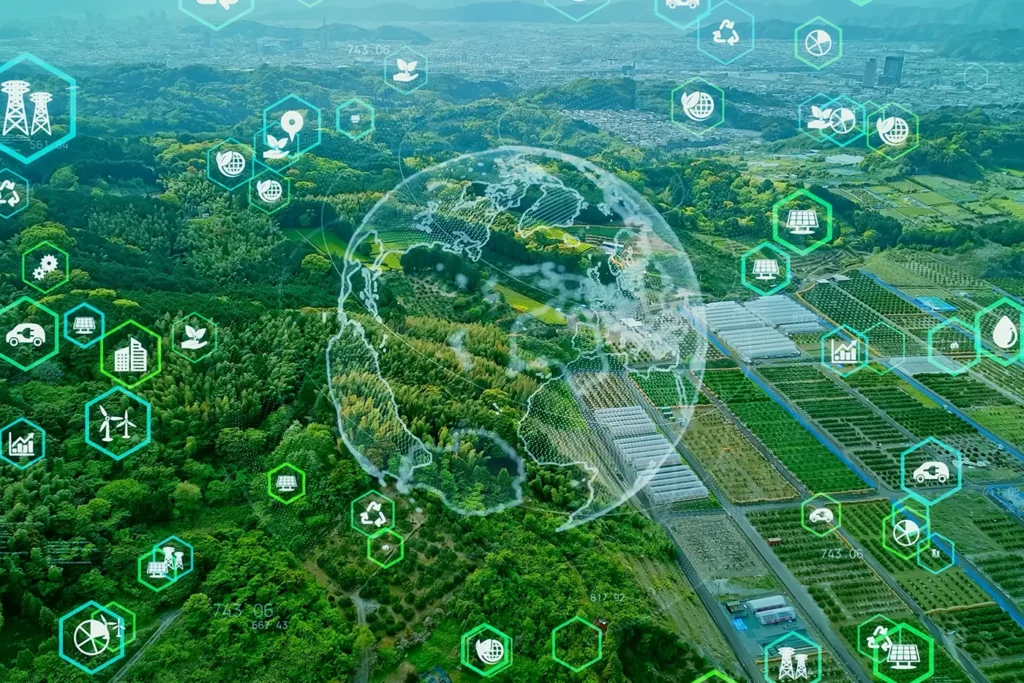
Artificial Intelligence can process environmental patterns, energy usage, logistics inefficiencies, weather fluctuations, waste behavior, and industrial performance at a speed no human system can match. That makes AI one of the strongest tools available to solve sustainability problems that traditional systems struggle with.
1. Smarter Energy Management
AI can predict power demand, reduce electricity waste, balance renewable energy loads, and help businesses run energy systems more efficiently.
2. Climate Prediction at Higher Accuracy
Machine learning can analyze years of atmospheric and environmental data to improve forecasting for floods, heatwaves, storms, and crop failures.
3. Intelligent Logistics and Fuel Reduction
AI-powered route planning reduces transportation delays, fuel burn, warehouse inefficiencies, and unnecessary emissions.
4. Sustainable Buildings and Smart Cities
From automated lighting to temperature optimization and occupancy-based systems, AI can significantly reduce building-level energy loss.
5. Better Waste and Resource Monitoring
AI vision systems are now being used in recycling, waste segregation, manufacturing quality control, and water management.
Studies indicate that if AI is strategically applied in transport, power systems, agriculture, and industrial efficiency, its climate-saving potential could eventually outweigh a significant portion of its own digital footprint.
6. Better Waste and Resource Monitoring
AI vision systems are now being used in recycling, waste segregation, manufacturing quality control, and water management.
Studies indicate that if AI is strategically applied in transport, power systems, agriculture, and industrial efficiency, its climate-saving potential could eventually outweigh a significant portion of its own digital footprint.
The Real Answer: AI Is Not the Villain – Unplanned AI Is
Blaming AI alone misses the bigger issue.
The problem is not intelligence.
The problem is irresponsible scale.
If businesses continue deploying AI purely for speed, automation, and profit without considering energy source, cloud architecture, model efficiency, and hardware sustainability, the environmental cost will rise sharply.
But if AI systems are designed with:
- green cloud infrastructure,
- renewable-powered data centers,
- efficient model engineering,
- low-energy automation workflows,
- and sustainability-first digital transformation,
then AI can evolve from being a climate pressure point into a climate solution engine.
This is the shift the tech industry must make now — not later.
Webdzo Technologies’ Perspective: Building Smarter AI with Responsibility
At Webdzo Technologies, we see Artificial Intelligence not simply as a productivity tool, but as a responsibility-driven innovation platform.
The future does not belong to businesses that only adopt AI.
It belongs to businesses that adopt AI intelligently.
That means creating digital systems that are:
- faster,
- scalable,
- business-efficient,
- and environmentally conscious.
Because the next era of technology will not be judged only by how advanced it is —
it will be judged by how sustainable that advancement remains.
Final Thoughts
So, is AI damaging the planet or saving it?
The honest answer is: it can do both.
Left unchecked, AI could become one of the digital age’s biggest hidden environmental costs.
But guided with renewable infrastructure, ethical engineering, and sustainable innovation, AI could become one of humanity’s most powerful tools to fight climate inefficiency, reduce emissions, and build a smarter green future.
The technology itself is neutral.
The future depends on how we choose to build it.
Ready to Grow with Us?
Got a project or idea? Scale your business with Webdzo Technologies! From cutting-edge website development to digital solutions tailored for success, we help turn your vision into reality.
📞 Call: +91 99522 89956
🌐 Visit: www.webdzo.com
Let’s build something amazing together!


Leave a Reply