
Next-Gen AI Marketing Strategy: How Businesses Are Winning Online
A few years ago, marketers spent hours writing content calendars, manually analyzing reports, replying to customer queries, and guessing what campaigns might work. Today, Artificial Intelligence is quietly transforming every part of digital marketing from content creation and customer targeting to automation and predictive analytics.
But here’s the reality: AI alone doesn’t create great marketing. Strategy does.
The brands growing fastest in 2026 are not simply “using AI tools.” They are building intelligent systems that combine human creativity with AI-powered efficiency. The result? Faster execution, smarter decisions, stronger personalization, and better ROI.
Why AI Has Become Essential for Modern Marketing
Consumers today expect everything instantly personalized recommendations, quick responses, relevant ads, and seamless online experiences. Traditional marketing methods struggle to keep up with this pace.
AI changes that completely.
Instead of spending days analyzing spreadsheets or brainstorming campaign ideas manually, marketers can now use AI to:
- Generate content ideas in seconds
- Predict customer behavior
- Automate repetitive tasks
- Personalize campaigns at scale
- Improve ad performance
- Track ROI more accurately
- Create better customer experiences
The biggest advantage isn’t replacing marketers it’s allowing them to focus on creativity, strategy, and growth while AI handles time-consuming processes.
What Makes an AI Digital Marketing Strategy Successful?
An effective AI marketing strategy isn’t about randomly using ChatGPT or automation software. It’s about creating a connected system where AI improves every stage of the customer journey.
1. Smarter Content Creation
Modern AI tools help marketers create blogs, ad copies, captions, emails, video scripts, and SEO content much faster. But the real power lies in combining AI speed with human storytelling.
The best-performing brands use AI to draft ideas while humans refine the emotion, tone, and originality behind the message.
2. Hyper-Personalized Customer Experiences
Today’s customers ignore generic marketing.
AI helps businesses understand:
- What customers click
- What they search for
- How long they stay on a page
- What products they prefer
- When they are most likely to buy
This allows brands to send highly personalized recommendations, emails, and ads that feel relevant rather than promotional.
3. Marketing Automation That Saves Time
One of AI’s biggest strengths is automation.
Businesses are now automating:
- Email sequences
- Social media scheduling
- Customer support chats
- Lead nurturing
- Audience segmentation
- Ad optimization
- Report generation
This reduces workload while improving consistency and customer engagement.
4. Predictive Analytics and Data Insights
AI doesn’t just analyze past performance — it predicts future trends.
Modern AI platforms can identify:
- Which campaign may perform best
- Which customers are likely to purchase
- Which audience may unsubscribe
- Which content format drives conversions
- Which platform delivers the highest ROI
Instead of guessing, marketers can make decisions based on real-time intelligence.
How to Build an AI Marketing Strategy That Actually Works
Start With Business Goals
Before selecting any AI tool, businesses need clarity.
Ask questions like:
- Do we want more leads?
- Better engagement?
- Higher conversions?
- Faster content production?
- Improved customer support?
- Reduced marketing costs?
AI should support business objectives not distract from them.
Use Data the Right Way
AI is only as powerful as the data it receives.
Brands should focus on:
- Website analytics
- Customer behavior
- Email performance
- Social media insights
- Purchase history
- Search trends
The cleaner and more accurate the data, the smarter the AI becomes.
Choose Tools Based on Purpose
Not every AI tool is necessary.
Some businesses need:
- Content generation tools
- CRM automation
- Predictive analytics
- AI chatbots
- SEO optimization platforms
- AI-powered design tools
The smartest approach is starting small, testing results, and scaling gradually.
The Rise of Human + AI Marketing
One major misconception is that AI replaces creativity.
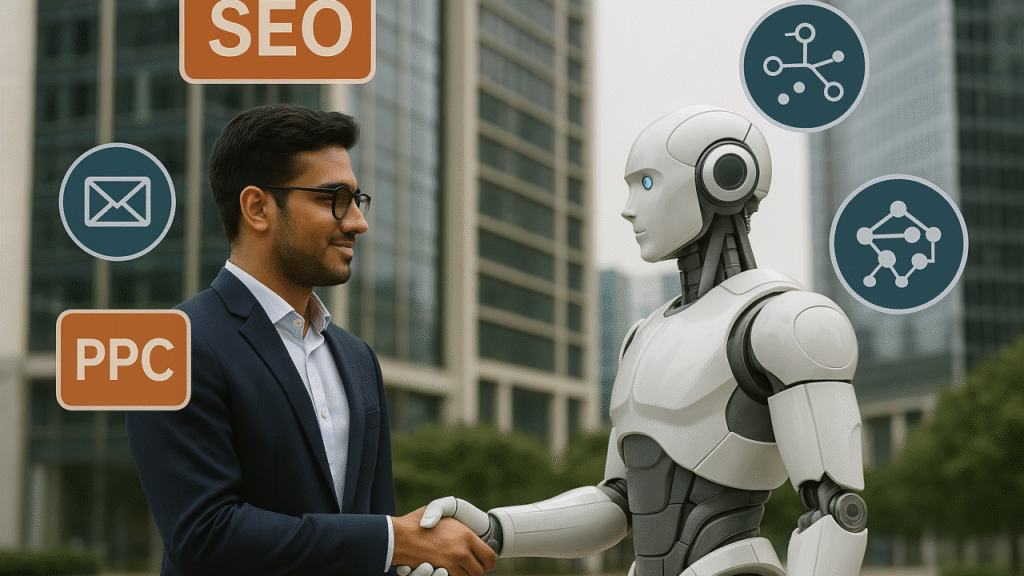
In reality, the most successful marketing campaigns still depend on human psychology, storytelling, emotion, and originality. AI simply accelerates the process.
The future belongs to marketers who know:
- How to think creatively
- How to guide AI effectively
- How to interpret data
- How to build authentic connections
AI can write content. Humans create meaning.
Ethical AI: The Side Brands Cannot Ignore
As AI becomes more powerful, ethical concerns are becoming more important.
Businesses must be careful about:
- Data privacy
- AI-generated misinformation
- Bias in automation
- Transparency in communication
- Overdependence on automation
Customers still value authenticity and trust. Brands that use AI responsibly will build stronger long-term relationships.
Final Thoughts: AI is Changing Marketing Faster Than Ever
Digital marketing in 2026 is no longer about working harder it’s about working smarter.
AI is helping businesses move faster, personalize deeper, and make better decisions. But the real competitive advantage comes from combining technology with human creativity and strategic thinking.
The brands that adapt early, learn continuously, and innovate fearlessly will dominate the digital space in the years ahead.
Because in the age of AI, attention is the new currency and strategy is what wins it.
Ready to Grow with Us?
Got a project or idea? Scale your business with Webdzo Technologies! From cutting-edge website development to digital solutions tailored for success, we help turn your vision into reality.
📞 Call: +91 99522 89956
🌐 Visit: www.webdzo.com
Let’s build something amazing together!

Leave a Reply